
Thermal Mass
Thermal Mass Meters – Principle of Operation
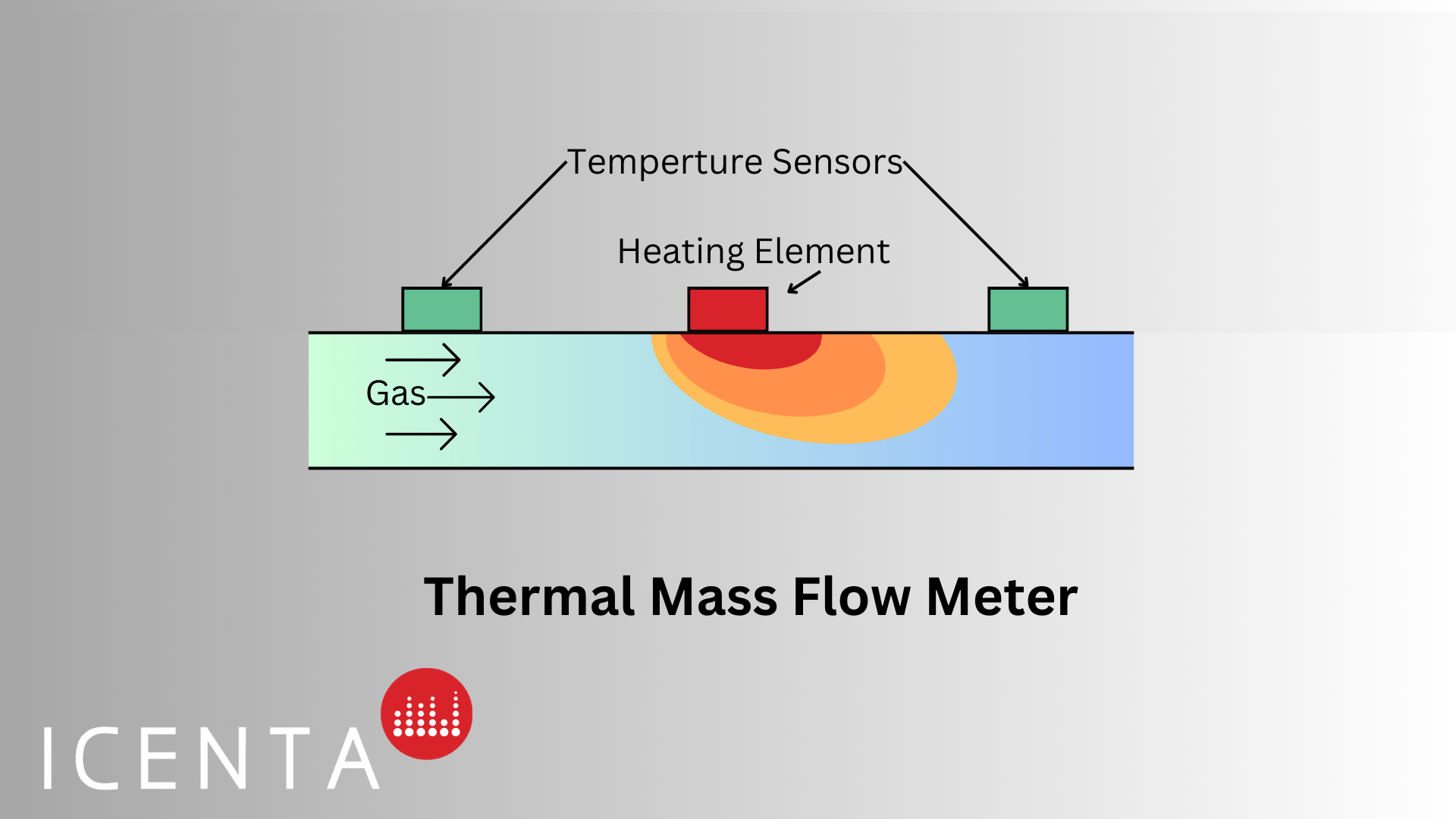
Thermal mass flow meters employ the thermal dispersion principle whereby the rate of heat absorbed by a fluid flowing in a pipe or duct is directly proportional to its mass flow. In a typical thermal mass flow meter, gas flowing over a source of heat absorbs the heat and cools the source. As flow increases, more heat is absorbed by the gas.
The amount of heat dissipated from the heat source is proportional to the gas mass flow and its thermal properties. Therefore, measurement of the heat transfer supplies data from which a mass flow rate may be calculated.
Thermal mass flow meters are designed to accurately monitor and measure mass flow (as opposed to measuring volumetric flow) of clean gases, a parameter that is not temperature dependent. Therefore, the thermal mass flow meter does not require a correction for changes in gas temperature, pressure, viscosity and density.
View our range of thermal mass flow meters.
Thermal Mass Flow Meter Advantages
- Measure gas mass flow rate directly
- Suitable for applications where temperature and pressures fluctuate
- Highly accurate and repeatable measurements with a typical accuracy of ± 1% FS
- Able to measure accurately low gas flow rates or low gas velocities
- Excellent turn down ratio, typically 50:1
- No moving parts
Thermal Mass Flow Meter Limitations
- Gas mass meter use is limited to clean, non abrasive fluids
- Presence of moisture or droplets can lead to measurement inaccuracy
- Thermal properties must be known: variation from calibrated values can cause inaccuracies
- Relatively high initial cost
Thermal mass flow meters are suitable for a variety of processes requiring mass flow measurement and are frequently used for the regulation of low gas flows. Some common gas flow applications for thermal mass flow meters include
- Compressed air flow and distribution
- Natural gas consumption eg for burner and boiler feed control
- Monitoring and control of stack or flue gas (where composition known)
- Landfill gas recovery
- Flare gas measurement
- Gas flow mixing & blending
- Gas leak testing and detection
We offer a wide range of thermal mass flow meters including Compact or SMART with or without ATEX approval.
Need Advice About Thermal Mass Flow Meters?
iCenta is a instrumentation and control solution specialist with experience in control technologies for diverse applications, fluid types and process conditions. Call iCenta now for advice, sales & technical information on 01722 439 880.